Posts

Showing posts with the label culture

Meet the neighbours: the trick to Halloween treats

Image
I both love and hate Halloween - probably, honestly, more the latter. It's not that it's "evil" or "of the devil". It's that it's so commercial. For weeks my inbox has been inundated with messages urging me to "avoid the fright" and "earn spooky bonus points" in attempts to get me to buy junk food I don't need. Halloween popped into Australia's consciousness in a vacuum. There is no storytelling attached to it, no cultural significance, no deeper meaning. Elsewhere it derived from a Christian feast on the eve of All Saints' Day, which is November 1, a time for remembering the dead, intertwined with the agricultural rituals of folk communities who gave thanks for the year's harvest. Here, it's just all about the sweets. In Mosman, on Sydney's North Shore, where two streets get besieged by children from all over the city, The Sydney Morning Herald reports some parents are spending $400, some as much...
A public health issue: Alan Jones and his violent metaphors

Image
Countless firms have pulled their support and advertising from Alan Jones’ radio program after his Jacinda Ardern comments. Just what will it take to suspend him? The managers of the station should take him off the airwaves, but not just for reasons of language. The reason to pull him off is public health. Let me explain. One of the greatest threats to health is violence. Australia has a shocking record of violence against women. On average, one woman a week is murdered by her current or former partner. Overwhelmingly, perpetratators of domestic or family violence against women and children are male. Factors associated with gender inequality are the most consistent predictors of violence against women including male peer to peer relations that emphasise aggression and disrespect towards women. Jones, who appears to have trouble with women of influence, feeds and helps legitimise an already-existing set of attitudes that condone violence. There is mounting evidence that pub...

The smartphone has become a metronome. This is how we change the beat

Image
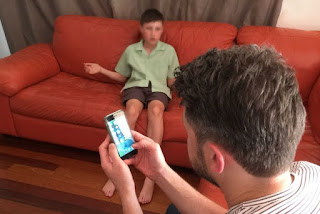
Without thinking about it much, children mimic their parents. It was when my husband — a veteran journalist — and I found ourselves glued to our phones for work at home, and tweeting compulsively, that I began to worry about what it was teaching our kids. What were we modelling? What was it doing to us? We were increasingly alone while together, particularly after our young teens retreated into their bedrooms to use their own smartphones, a development that quickened their inevitable withdrawal from us. Cyberspace is more intense and exciting than the real world, a world of continuous competition and commerce. It's also easier to navigate. But what grabs our attention there isn't necessarily what's needed for us to grow well. While we were working out boundaries for our children, I began to think about boundaries for us, looking for other ways to find joy and meaning in our own lives in the hope we could spark it in our kids, because it isn't children who are driv...

Tricked into forced marriage: cultures of control

Image
Eighteen year-old Fatima (not her real name) was tricked by her parents into leaving Australia. On board the plane they told her she had to marry a much older stranger. She didn't want to. They threatened her and took away her passport. The wedding took place behind closed doors. Distressed, she logged onto My Blue Sky, a relatively new website with a secure communications portal funded by the Australian government and operated by Anti-Slavery Australia. Its administrators contacted Foreign Affairs and arranged for a replacement passport. One of Fatima’s friends drove her to the airport. One of Anti-Slavery Australia's overseas partners helped fund the flight. It was a perilous escape. Much could have gone wrong, but Fatima made it home. Others aren’t as fortunate. “I am just worried about all the women and girls who don't contact us,” says Professor Jennifer Burn, the director of Anti-Slavery Australia which is housed in the law faculty at the University of Techn...

School leavers need celebration options that don't include grog

Image
It's the schoolies week season. Not taking any risks, an acquaintance with a 17-year old daughter booked a trip for her and her friend to a tropical island, each with their father. Anything to avoid an underage booze-up. It's that time of year when there's a rash of parties that provide alcohol to children. The school formals are (meant to be) alcohol-free but the pre and post-formal parties are not. It's well-established that consuming alcohol early in life, right up to age 21, damages developing brains. Early consumption seems to lead to alcohol-dependence and other problems later in life. Supervised drinking isn't safe either. Studies show that when parents supply alcohol at children's celebrations, thinking they are teaching them about control, they actually encourage heavier drinking. Exposure to alcohol leads to drinking. The message seems to be getting through. Official statistics show Australian teenagers are drinking less and start to drink alco...

'Is she addicted to texting?' Recruiters increasingly ask this question

Image
A true story. A young woman was applying for a job in the Australian Public Service. She needed a security clearance and character references. A friend took the call. It would take 15 minutes. The questions were standard until one of the last: "Is your friend, in your view, addicted to texting?" The questions that followed were about computer use and phone use more generally. You can guess there's a problem when questionnaires designed to gauge the suitability of employees ask about texting. While the Community and Public Sector Union tells me it is not standard for candidates to be asked about their device use directly, it is very likely that their acquaintances are asked about it, directly and indirectly. There's no doubt that texting is a relevant consideration for security, but it's probably also relevant for something else: the ability to get on with meaningful work. While powerful tools that, when used prudently, can help the mind, mobile devices can a...

Violence in Virginia reflects worldwide national identity debates

Violence in Charlottesville in U.S. Virginia this week between neo-Nazis and anti-racism groups is a symptom of resentment over social change, how history is remembered and the heroes communities decide to celebrate or reject. In Virginia the clashes were sparked by heated debate about the future of a statue of Confederate General, Robert E Lee. "It was erected at a time when there was this rising myth of the glory of the south, the white nationalist south," says local councillor Kristin Szakos who has sought to move the statue from the public square, prompting outrage from the far-right. "Lee was a symbol of all that was good in pre-war southern society - meaning slavery, white people had dominance and economic power," Szakos told the ABC. Hours after the Charlottesville violence, anti-racist protesters in North Carolina toppled a Confederate statue there - pulling it to the ground and stomping on it. White nationalist organisers see themselves as defenders ...

Questions of community and connection as Canberra goes high density

With a fraction of the population of truly global cities Sydney and Melbourne, Canberra is suddenly aiming for the sky. International flights to Singapore and Wellington are just part of it. Every edition of The Canberra Times seems to report a new development that tests expectations of what the city is or should be. The latest controversy is a six-storey apartment block planned to replace the single-storey shops at Curtin, shading the community square. We're told high-density living is needed if we are to sustainably grow. Besides, it was in Walter Burley Griffin's plan. But the Griffin legacy, as with the vision of Charles Weston (who pioneered the greening of Canberra), means different things to different people. Let's look at the residential complex that takes its name from the island that houses New York. Manhattan on the Park shadows Civic's Glebe Park. It and other buildings like it in Woden and Belconnen are being sold as designer luxury living "close...

It takes a village to prevent institutional child abuse

"It takes a village..." was perhaps Hillary Clinton's most memorable line. It was given a macabre twist in the Academy award-winning movie Spotlight, about the cover-up of sexual abuse by Catholic Church clergy in Boston. One of the actors observed that "if it takes a village to raise a child, it takes a village to abuse one". We are about to learn more about the NSW "village" of Newcastle, in which an extraordinary number of respected citizens appear, through action or inaction, to have helped cover up allegations of sexual abuse. Four years after Julia Gillard announced the royal commission into institutional responses to abuse, the Anglican Bishop of Newcastle, Greg Thompson, is due to take the stand on Wednesday in Sydney when the commission reconvenes for case study 42. He has already given evidence privately, as perhaps the most senior clergyman to do so. He grew up in the Hunter Valley and was sexually abused while a university student in Ne...

Pokemania a sad indictment on the state of play

Image
Nintendo's mobile-gaming "miracle" Pokemon Go may be bringing millennials out of the house – of their own free will – but its success says a lot about how the whole idea of play has changed, for the worse. The app may be free for smart phone users, but this is pure commerce. It's created what marketers want: more spending in the shops that have shelled out fees to become physical destinations for Pokemaniacs. Yuk. Play has always been about constructing and imagining reality. Now it's about flogging products. It's transforming and reducing homes, memorials and cemeteries into spaces for so-called play, with an eye to profit. It's cannibalising real-world geography, in contrast to traditional play that's bounded inside a "magic circle" in which children play act without corporate scripts. Children of my generation born in the 1970s had the freedom to get dirty, to climb trees and experience real danger. My parents and their friends did e...

Digital election campaign means less time to reflect on the issues

Image
More than any previous election campaign this one will be won or lost using digital media. Millions of us are wedded to Facebook. It's a vast digital kingdom that each party will try to conquer. These days we are living more in our heads and less in the real world. We have fewer embodied and spontaneous experiences with strangers, and more disembodied ones, although usually with people we have chosen to follow; people whose political preferences align with our own. It's made us more tribal, more like the followers of Donald Trump, given us more blindspots. The upside is that many of us are able to engage directly with members of Parliament, even the Prime Minister. And fact-checking is easier once you establish which sources to trust. Meanwhile, journalists are under siege. Those on the campaign trail are tethered to devices that won't let them rest, and they are encouraged to use them to engage with the public when they've time to spare – time they would have ...

This Lent, why not give up speed, live in the present

Image
Australian painter Jeffrey Smart created semi-urban landscapes where huge windowless buildings sat in harsh light. They were props surrounded by small, often puzzled and isolated figures. The landscape taking shape between Majura and Fyshwick has echoes of a Smart. There's something surreal about towering retail temples ribboned by hills dotted with sheep. Bold fluorescent signs point to giant warehouses circled by grey car parks, like moats hugging corrugated exteriors. People move in and out of vehicles in an orderly fashion, dwarfed by the primary-coloured Ikea, Costco and Masters hardware store. Ikea promises a kind of rebirth. Its thick catalogue soothes with new endless possibilities for clean and sunlit interiors. The rooms of our lives can be realigned. Just swipe your card. So mesmerised are we that we imagine waking up the next morning blonde and living with less clutter, comforted inside one of the world's best welfare states, a Scandinavian country built aro...

The seductions of the beach

Image
If the bush represents the sweat of hard work and childhoods in suburbs sprawling into a scrub frontier then the bleached sand and cool sea is where we choose to escape our pimpled and later ageing selves. So contends author Robert Drewe in his new book, The Beach . He argues the beach is part of the Australian consciousness at many levels. We are called to the edges of the continent to find refreshment and the promise of renewal. But it's also where early intrepid travellers, settlers and convicts first encountered Aboriginal peoples; where mutual curiosity turned into clashes. There are more than 11,000 sandy beaches in Australia, each with their own secrets, sand flies, jellyfish and near or actual drownings. They are where our anxieties play out (shark!) and where our moral values are tested. They are where people experience intimacy and intrusion, rescue and rejection. The backdrop for the Cronulla riots a decade ago, the beach represents a lifestyle and philosophy, view...

Control orders on 14-year-olds an ethical dilemma

As the so-called war on terror escalates in the wake of the bombings in France, Attorney-General George Brandis wants to give police the power to place control orders on suspects as young as 14. Control orders allow active monitoring, 1984 -style. Can they prevent acts of violence? The evidence suggests they can. As well as enabling the collection of evidence, control orders disrupt plans. But the proposed law, part of a suite of anti-terror measures being investigated by a parliamentary committee, creates an ethical dilemma – especially at a time when the values of the West are under threat. In Western society it isn't normally a crime to think something. How can it be right to severely limit the freedom of someone as young as 14, just because they *might* later commit a crime? It'll inevitably mean profiling. Islam doesn't have a monopoly on violence, but that's where the police will look. They don't have the resources to look everywhere. Control ord...

Romantic love: what's it good for?

Image
In her best-selling 1970 work The Female Eunuch , Germaine Greer urged a great awakening; for women to exercise their freedoms and stop being passive. The Bachelorette put that to the test, 45 years later. The female lead, 26-year-old Sam Frost, was indeed in the driver's seat, choosing a man on her own terms. She asserted her virility. In the last few episodes she intensely kissed all the men still standing. But on the other hand, Frost was an advertiser's dream. Projected as The Ideal, she was slim, symmetrical, fair-skinned and mostly discreet. Ours is a culture that urges individuality, but then pushes on us perpetual "types". Television does it best. The dwindling list of chosen blokes were all chiseled and sporty. Hundreds of thousands of us watched it because we structure our whole lives around romantic love, philosophy Professor Carrie Ichikawa Jenkins of British Columbia University says. It's a powerful force, yet we rarely wrestle with what i...

I Consume Therefore I Am?

Image
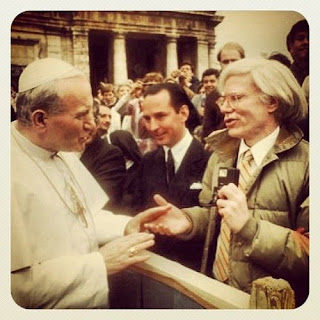
Buying is much more American than thinking, pop artist Andy Warhol once quipped. On last month’s visit to the United States, Catholic Pope Francis generated an enormous market for ‘things’, both spiritual and commercial. It was thick with irony. While personally devoted to simplicity, Francis unleashed a hunger for products that surpassed what is usually associated with rock tours. New York was flooded with Pope posters, 'the Pope gives hope’ t-shirts, Pope caps, Pope bracelets and even Pope cheese that could be spread on Pope toast and then washed down with Pope beer. Instead of singing the hymn “The Great I Am” believers could have been singing “I Consume Therefore I Am”. What is it about the human condition that makes us feel the need to bottle or wear things that are fleeting, even sacred, things that can’t be bottled or worn? Francis talks about being saved by the divine, of being in the world but not of it, yet all around him marketeers are offering objects that promise s...

Deep democracy: a new model for politics?

It's been said often these past few days that Tony Abbott's prime ministership achieved little of substance. But that doesn't mean it didn't leave a legacy. Adding to the dysfunction of the Labor years, for many it left a deeper disillusionment with politics, a thicker poison. Our disdain for politicians, our fatigue with their combativeness and repetition, remains. We got a lot of blame but few solutions. Malcolm Turnbull's win doesn't yet seem real. Could we really hope for something more sophisticated? Abbott talked about creating opportunities but shut blinds, narrowed pathways. His pattern of support for powerful interests such as banks and coal mining companies over their customers and competing interests further disempowered the least powerful. Abbott talked once about looking after "forgotten families" but made us brittle, more anxious and heartsick. However, he didn't kill our interest in politics. For some he did the opposite - he f...

Sex education: Start young and be frank

If we are serious about tackling interpersonal and family violence, work to prevent it has to start young. But how young? The answer is: as young as kindergarten, age five. That was the recommendation made this week by campaigner Rosie Batty in her appearance before Victoria's Royal Commission into Family Violence. It sits well with the evidence local groups have been amassing here in Canberra, where three women were killed by violent partners in quick succession earlier this year. One of them is YWCA Canberra which, in partnership with ACT Office of Women, has just launched a web-based resource called Relationships Things. It deals with what many parents and even schools don't, or don't deal with well – sex, and questions of consent. Even though sex education is formally part of the curriculum, its delivery is patchy. Too many schools don't do it. "We have the birds and the bees and 'just say no', that's it," says Michael Flood who resea...

Barefoot and passionate: reflections on the Lenten experience

Image
Ahead of Easter and the end of Lent I was delighted to discover an exquisite baroque sculpture by the Italian artist Gian Lorenzo Bernini. It's of St Teresa of Avila, the Spanish founder of the Discalced Carmelites. Google her. In a small Roman chapel St Teresa can be found, made of marble seated on clouds below an angel poised to pierce her heart with a dart. In her autobiography, Teresa describes this spiritual ecstasy as one that causes immense joy and pain; turning her "on fire with a great love of God". Leaving aside Teresa's mystical encounter, I was curious to know why she was discalced, that is barefoot. The Discalced Carmelites, a Catholic order established in the late 1500s, understood that we experience the world and beyond through our bodies. Going without shoes, and in her case other comforts, was a sign that she relied on God to provide for her. It's a concept foreign to most of us. We strive to be independent. Going barefoot is associated with bei...