Posts

Showing posts with the label democracy

It hurt as I breathed: history repeats itself

Image
“They would catch me, I saw, half turning round to see my rear but still kicking my heels forward. ‘Nigger nigger - catch a nigger by the toe, eeny meany miney mo!’.” So begins a story by African American Peggy Dye, describing her childhood when she crossed uptown Illinois to study in a majority white school with a small black quota. It was a school her parents encouraged her to attend, knowing she was smart. But there were risks. It was a school full of white boys who thought all Negroes (the word used) were “cold-black and violent”. They’d chase her home. “‘Get away from me!’ I panted as I pumped my 18-inch legs. ‘Please!’ and I felt the tears in my eyes. I was running and trying so hard not to fight, choking down the anger. I was resisting. I felt a big pain in my stomach. Was it anger? It was a rock and it rolled inside my ribs and hurt as I breathed.” Still running It was the late 1940s. Dye had just started first grade when her father told her, “‘It’s a war baby, and don’...

What we need in a new ABC managing director

Image
Behind all the talk about the independence of the ABC lies a separate but gnawing concern that populism is increasingly trumping depth in the making of its programs. Michelle Guthrie was a late convert to quality reporting (staff still wince recalling her early advice to makers of Four Corners, that they should try doing some positive profiles of successful business leaders). But under her, and under budget pressure, senior management have been hacking away at serious programs in order to make way for topical and lighter fare. It has narrowed the range of topics focused on by those programs and limited their depth. Guthrie presided over a downsizing of the ABC’s flagship current affairs programs The World Today and PM, cutting both from one hour to half an hour. The "ideas network", Radio National, was thinned as management began earnestly shifting the network into a podcast-making machine that can one day be moved off the broadcast airwaves altogether. Management m...

The important and humbling work of doing diversity

Image
Growing up in suburban Sydney, I broke bread with all kinds. The dismantling of the White Australia policy in the 1960s and 1970s had allowed my parents to bring me from South Africa, aspire to belong and buy a house on a quarter acre block. My father started a business. Schooled in Islam, he ensured we never ate pork. I went to a public school alongside Aboriginal, Slavic, Italian, Greek and Malay students, as well as Anglos. Embracing the Jesus story, I found mentors in a diverse and welcoming community in Anglican and Baptist churches while still connected to my Muslim family. Canberra is less diverse, but still very welcoming. Here in the national capital, Senator Fraser Anning made a splash when he called for an end to immigrants who do not reflect “the historic European Christian composition of Australian society”. He’s been roundly condemned. What Anning may not have heard loud and clear is that Jesus was not European. He’d be forgiven for thinking otherwise if in a Wes...

Evidence should lead planning in Canberra

Image
It’s getting harder to believe, but Canberra’s forefathers wanted to create “a garden town, with simple, pleasing, but unpretentious buildings”. For most of its life, that’s how Canberra has been. Except that recently there has been an emphasis on towers that threaten to block views and plunge streets into shade. It’s not something any of us remember voting for. We are often told that packing people in more densely is good for the environment. It is said to mean less water and energy use per person. Except that it doesn’t, according to fascinating but little-known research commissioned by the ACT Environment and Planning Directorate and conducted by Patrick Troy, Mishka Talent and Stephen Dovers at the ANU. It found no significant difference in water and electricity use between residents of apartments and houses. While people with gardens used more water in summer, they were more careful in what they used at other times, acting as stewards of their environment. Apartment dwelle...

Govt tries to gag public-interest advocates, again

Image
The Coalition has been waging war against those who've dared to question it since 2013. Its latest gagging grenade has been lobbed under the cover of foreign donations reform, bizarrely egged on by the largely foreign owned mining industry. On election Tony Abbott tried to abolish the newly-legislated Charities Act which enshrined in law the right for charities to engage in political advocacy. There's not much point in (for example) trying to house the homeless without also trying to remove the causes of homelessness. The Act set up an Australian Charities and Not-for-Profits Commission as a one-stop shop for keeping tabs on and assisting charities, as recommended by the Productivity Commission. Abbott lost that battle after the charities themselves appealed to cross benches. Then he tried to strip environment groups of their charitable status. His environment minister Greg Hunt set up an inquiry that recommended they lose the right to tax deductible donations unless th...

Facebook is ripping society apart, and other reasons to rethink social media

Image
When Chamath Palihapitiya joined Facebook in 2007, it had 50 million users. By the time he left after four years, it had 800 million. He was its vice-president for user growth. These days, he feels tremendously guilty. "I think we all knew in the back of our minds, even though we feigned this whole line that there probably aren't any bad consequences, I think in the deep recesses of our minds we kind of knew something bad could happen," he told the Stanford Business School last month and reported for the first time this week. "The short-term, dopamine-driven feedback loops that we've created are destroying how society works. No civil discourse, no co-operation, misinformation, mistruth, and it's not an American problem - this is not about Russian ads - this is a global problem. "We curate our lives around this perceived sense of perfection, because we get rewarded with these short-term signals - hearts, likes, thumbs-up -and we conflate that with...

The power of lament and song

Image
The idea of lament feels strange as it is ancient. There are images of it in biblical times, of people wailing and gnashing their teeth. It feels like the season for wailing now: wailing about the demise of positive politics, about political strategy trumping real solutions and about the early death of human rights. Haven't there always been things to wail about? Yes, but now we live with unceasing streams of media exposing us to the world's pain as never before and an ugly kind of tribal politics that makes resolving differences seem impossible. Song is a place to go, to sit with lament and to release it. Canberra's Chorus of Women sprang out of a deep lament in 2003 as prime minister John Howard took Australia to war in Iraq, despite an overwhelming majority of Australians opposing it. About 150 women, not then a formal group, broke into song in the marble foyer of Parliament House. They cried in unaccompanied song for the people of Iraq, the inevitability of deat...

The seductions of the beach

Image
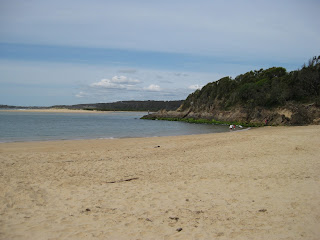
If the bush represents the sweat of hard work and childhoods in suburbs sprawling into a scrub frontier then the bleached sand and cool sea is where we choose to escape our pimpled and later ageing selves. So contends author Robert Drewe in his new book, The Beach . He argues the beach is part of the Australian consciousness at many levels. We are called to the edges of the continent to find refreshment and the promise of renewal. But it's also where early intrepid travellers, settlers and convicts first encountered Aboriginal peoples; where mutual curiosity turned into clashes. There are more than 11,000 sandy beaches in Australia, each with their own secrets, sand flies, jellyfish and near or actual drownings. They are where our anxieties play out (shark!) and where our moral values are tested. They are where people experience intimacy and intrusion, rescue and rejection. The backdrop for the Cronulla riots a decade ago, the beach represents a lifestyle and philosophy, view...

Deep democracy: a new model for politics?

It's been said often these past few days that Tony Abbott's prime ministership achieved little of substance. But that doesn't mean it didn't leave a legacy. Adding to the dysfunction of the Labor years, for many it left a deeper disillusionment with politics, a thicker poison. Our disdain for politicians, our fatigue with their combativeness and repetition, remains. We got a lot of blame but few solutions. Malcolm Turnbull's win doesn't yet seem real. Could we really hope for something more sophisticated? Abbott talked about creating opportunities but shut blinds, narrowed pathways. His pattern of support for powerful interests such as banks and coal mining companies over their customers and competing interests further disempowered the least powerful. Abbott talked once about looking after "forgotten families" but made us brittle, more anxious and heartsick. However, he didn't kill our interest in politics. For some he did the opposite - he f...