Posts

Showing posts with the label screens

Feed Play Love: Laying the groundwork for a healthy digital family life

The COVID-19 lockdown has, among other things, laid bare our modern lives and how dependent we are on digital technology for just about everything. Creating boundaries with our children around screen-use just got a whole lot harder. This period has also provoked questions around the role of education. What is the purpose of school? Students can find information on everything online but knowledge found there is only really useful when it's integrated with what they know. Integration is supported by conversation. A class environment can provide that, so too, the home. Last September I recorded this podcast which explores some of the above. Listen to Feed Play Love: Laying the groundwork for a healthy digital family life here


Mental health: making real productivity gains post COVID

Image
For many of us, forced to work at home or to not work at all, the COVID-19 crisis has driven home the importance of mental health and how work interacts with our sense of wellbeing. World leading researchers and mental health experts have warned that as the virus subsides, we will see a big surge in the need for mental health care and pain management. A stretched mental health system will be under increased pressure. Young people, hit hard by the closure of schools and hospitality businesses, are going to be disproportionately affected. So it’s with anticipation then that the Productivity Commission will soon release its final report of its 18-month inquiry into mental health and productivity. The draft report, released in October, was a good start but the final report will need to be more holistic - with the social determinants of mental health as a guiding principle - to inspire confidence. The draft report found that the economic costs of poor mental health were shockingly...

The future of work as the digital disrupts

Australian students are continuing to slide in international performance tables, with ACT students going down about as fast as (but typically still doing better than) those in the rest of Australia. The Organisation for Economic Co-operation and Development conducts its Program for International Student Assessment (PISA) survey of performance in reading, maths and science every three years. It finds that although the performance of Australian students is close to the OECD average, unusually among developed countries, Australia's performance has been getting worse over time. Should it worry us? That depends partly on what we think will be needed for living in and surviving the rest of the century. There's no necessary reason to think it will be maths and science as we've known them. Machines might do those things for us. But a mid-year report by Deloitte Access Economics finds employment has been growing fastest among the least routine jobs, the ones that machines ca...

Time to reclaim the lifeblood of human society

Image
In the lead up to last week’s School Strike 4 Climate, a tweet jumped out at me. “Why are so many young people depressed?” it asked, and then presented two different answers. Teenagers: The adults have f***ed up the planet and our future. Adults: It’s the phones. Of course, both might be true. Depression might be sparked by the fate of the planet, but then fed by incremental updates and outrage delivered to smartphones in our pockets all the time. It isn’t what used to happen. Panic about 1980s' concerns such as nuclear war weren’t amplified and fed back to us through a hyperconnected echo chamber. It most certainly is bad for our health. Studies show that as screen time increases, so too do rates of teenage suicide and depression. Lead researcher Jean M. Twenge of San Diego State University compared US statistics on teenage suicide deaths, suicide-related outcomes and adolescents’ depressive symptoms, with new media use. He found adolescents who spent more time on new ...

The smartphone has become a metronome. This is how we change the beat

Image
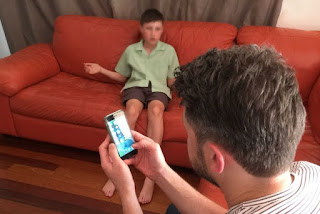
Without thinking about it much, children mimic their parents. It was when my husband — a veteran journalist — and I found ourselves glued to our phones for work at home, and tweeting compulsively, that I began to worry about what it was teaching our kids. What were we modelling? What was it doing to us? We were increasingly alone while together, particularly after our young teens retreated into their bedrooms to use their own smartphones, a development that quickened their inevitable withdrawal from us. Cyberspace is more intense and exciting than the real world, a world of continuous competition and commerce. It's also easier to navigate. But what grabs our attention there isn't necessarily what's needed for us to grow well. While we were working out boundaries for our children, I began to think about boundaries for us, looking for other ways to find joy and meaning in our own lives in the hope we could spark it in our kids, because it isn't children who are driv...