Posts

Finding hope amid the doom of climate change

Image
After another frigid and dry Canberra winter, I've welcomed the warmer weather with joy. Yet it's increasingly too warm to leave a lasting smile. We are told to brace for punishing summers. In a new book, Plutocene: Blueprints for a Post-Anthropocene Greenhouse Earth , the Australian National University's Dr Andrew Glikson says there's no turning back the greenhouse clock. He foresees mass extinctions and a breakdown of civilisation. In his book, Defiant Earth , Clive Hamilton of the Canberra-based Centre for Applied Philosophy and Public Ethics foresees something even worse: the possibility of our own extinction by an untameable Earth. Hamilton writes it will probably be hundreds of thousands of years before most of the large reserves of carbon released during the human age can be rendered immobile again. People have rivaled the great forces of nature so much so that we have changed the functions of the planet for an era. The Arctic is vanishing as is the Greenl...

Australia's pitiful efforts to aid Rohingya refugees

Image
Imagine the entire population of Canberra driven from their homes in mere weeks. That's the scale of what's happening in predominantly Buddhist Myanmar, once known as Burma. More than 300,000 persecuted Muslim Rohingya were forced to leave their torched villages in the past month. Australia's response has been a disgrace, all the more so amid our campaign for a seat on the United Nations Human Rights Council. We've offered just $5 million to the emergency relief effort, a pittance compared to the $122 million we are spending surveying opinions on whether same sex-couples should be able to marry. Foreign Minister Julie Bishop says she's "deeply concerned" and has called for "restraint". Australia is the richest kid on the block. This is our region. The Rohingya have been persecuted for years because of their darker skin and different religion. There have been forced displacements dating back to the 1990s. In February this year, a UN report...

'Is she addicted to texting?' Recruiters increasingly ask this question

Image
A true story. A young woman was applying for a job in the Australian Public Service. She needed a security clearance and character references. A friend took the call. It would take 15 minutes. The questions were standard until one of the last: "Is your friend, in your view, addicted to texting?" The questions that followed were about computer use and phone use more generally. You can guess there's a problem when questionnaires designed to gauge the suitability of employees ask about texting. While the Community and Public Sector Union tells me it is not standard for candidates to be asked about their device use directly, it is very likely that their acquaintances are asked about it, directly and indirectly. There's no doubt that texting is a relevant consideration for security, but it's probably also relevant for something else: the ability to get on with meaningful work. While powerful tools that, when used prudently, can help the mind, mobile devices can a...

Violence in Virginia reflects worldwide national identity debates

Violence in Charlottesville in U.S. Virginia this week between neo-Nazis and anti-racism groups is a symptom of resentment over social change, how history is remembered and the heroes communities decide to celebrate or reject. In Virginia the clashes were sparked by heated debate about the future of a statue of Confederate General, Robert E Lee. "It was erected at a time when there was this rising myth of the glory of the south, the white nationalist south," says local councillor Kristin Szakos who has sought to move the statue from the public square, prompting outrage from the far-right. "Lee was a symbol of all that was good in pre-war southern society - meaning slavery, white people had dominance and economic power," Szakos told the ABC. Hours after the Charlottesville violence, anti-racist protesters in North Carolina toppled a Confederate statue there - pulling it to the ground and stomping on it. White nationalist organisers see themselves as defenders ...

Improvised, free-range play a wonderful antidote in the digital age

Suddenly, Canberra appears awash with real play spaces. One's just opened at my local primary school complete with tunnels, a dry creek bed and undulations that children clamber around, and play games that they create rather than have created for them. Being an unfenced public school, it shares the space with the neighbourhood after school hours and on the weekends, making the school more secure. At nearby Ainslie Primary School there are now two so-called 'play pods' - shipping containers packed with things such as milk crates, crutches and loose wheels. The contents are neither entirely safe nor totally dangerous. With children as young as six about to be subject to national tests on what they've learnt, play has never been more important. Unlike tests in which there are right answers, undirected play is open, not closed. It allows children to develop their own rules and to learn at their own rates. It actually helps them become smart. Play, unmediated by ru...

Learning lessons from the London Grenfell Tower fire

Image
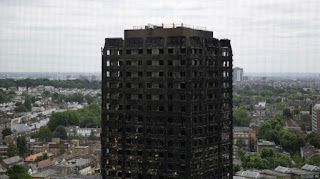
The burnt out shell of London's Grenfell Tower is a tragic reminder of the important role of governments in ensuring people are properly housed. Outsourcing or weakly enforcing standards leads to calamity. Grenfell Tower was clad with highly combustible foam and aluminum, chosen because it was cheaper. The building had no sprinkler system or evacuation plan. The residents were mostly poor. Under pressure, British Prime Minister Theresa May conceded that "for too long in our country, under governments of both colours, we simply haven't given enough attention to social housing". "This itself is actually a symptom of an even more fundamental issue," she said. "In this tower just a few miles from the houses of parliament, and in the heart of our great city, people live a fundamentally different life, do not feel the state works for them and are therefore mistrustful of it." In Australia we are chronically short of public and social housing. We ...

Left behind? Progressive Australians' reluctant to talk religion

Image
Why is it that the louder a Christian politician talks about their faith the more conservative they seem to be? Cory Bernardi, who split recently from the Liberal Party, is among those who have come to epitomise the idea of a Christian politician, arguing that Australia is and should remain Christian. One Nation's Pauline Hanson said repeatedly before last year's election that Australia was a "Christian country", although in her maiden speech as a senator she also noted that its government was secular. Bernardi cites the constitution as evidence that Australia is Christian and Nationals senator John Williams wants the Lord's Prayer to be part of the school system. But there are many more Christian politicians I have been talking to who think very differently. Recently elected West Australian Liberal MP Andrew Hastie, a former air services officer, says he gets "uncomfortable when people start calling Australia a Christian nation". "I think t...